Claude SEO: Audit Your Website With Claude Code
Last updated Oct 14, 2026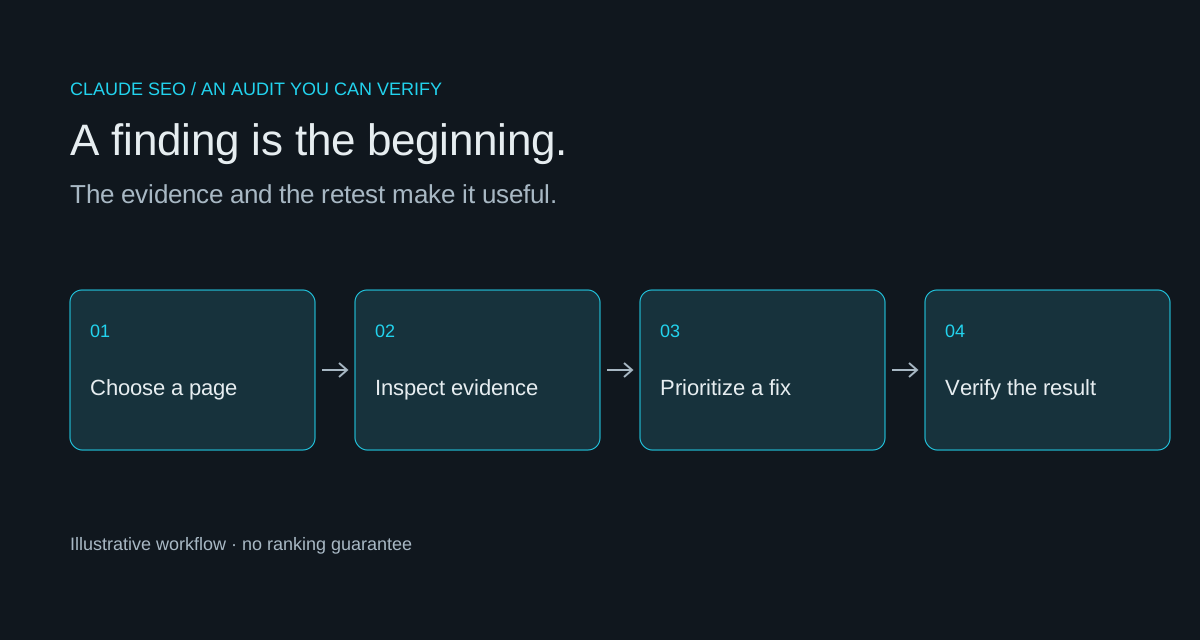
Claude SEO is an open-source plugin by AgriciDaniel that gives Claude Code workflows for auditing technical SEO, content, structured data, and AI search readiness. It helps organize observations into a prioritized action plan. I find that useful because a website audit should end with changes I can check, rather than a score I cannot explain.
What does Claude SEO help you review?
The plugin brings several kinds of review into one workflow: whether pages can be crawled, how titles and canonicals describe them, whether structured data matches the page, and whether the content actually answers a reader’s question. A full audit covers more ground; a single-page audit is a better starting point when you already know which article needs attention.
Treat its output as a set of hypotheses. An agent may identify a real issue, miss context, or overstate the importance of a finding. Before changing a page, follow the evidence back to the rendered HTML, a measured report, or the relevant official documentation. The plugin is a useful second pair of eyes, not access to Google’s internal ranking systems.
How do you install the plugin?
In Claude Code, add the public marketplace and install the plugin. The upstream setup command prepares its runtime; doctor checks that setup. These are Claude Code commands, not commands to paste into your terminal.
/plugin marketplace add AgriciDaniel/claude-seo
/plugin install claude-seo@agricidaniel-claude-seo
/seo setup
/seo doctor
Use the upstream installation guide for current requirements and optional integrations. The public code is MIT licensed, but running your agent and connecting paid data services may still cost money. Installing the plugin does not connect your Analytics or Search Console accounts automatically.
Which audit should you run first?
/seo page https://example.com/article
/seo audit https://example.com
/seo schema https://example.com
/seo geo https://example.com/article
Start with /seo page when your goal is to improve one article. Use /seo audit to review the site more broadly, /seo schema to examine structured data, and /seo geo to review readiness for AI search through ordinary SEO fundamentals. Replace example.com with a site you are authorized to review.
How do you turn findings into fixes?
My review sequence is observation, evidence, change, verification. Suppose an audit says two pages use the same canonical URL. I inspect both HTML responses, identify whether the duplication is intentional, correct the specific canonical if needed, and request the pages again. “The report says so” is not a sufficient acceptance test.
- Prioritize broken access, indexing directives, and incorrect canonicals before wording tweaks.
- Ask for the affected URL, supporting evidence, and a way to retest each recommendation.
- Separate measured results from inferred scores and unsupported claims.
- Keep the original finding with the change so the next audit can check whether it was resolved.
What might a useful finding look like?
Illustrative example only — this is not an audit result for getAngad or a customer website:
Observation: /guides/intro has a canonical pointing to /guides/old.
Evidence: the canonical link in the HTML response.
Question: is /guides/intro intended to be a distinct indexed page?
Change: use its own canonical if the answer is yes.
Verify: fetch the HTML again and inspect the canonical link.
Does GEO require special writing tricks?
No special phrasing guarantees an AI citation. Clear answers, original experience, useful images, accessible pages, and honest attribution help readers. Google’s AI optimization guide explains that its generative search features build on Search fundamentals. It also says Google Search ignores llms.txt; that file is not a shortcut to rankings.
Where can you go next?
Read the Claude SEO repository and Claude Code skill documentation. For another example of giving an agent a focused workflow, see the grill-me installation guide. For making findings easier to discuss, see my Mermaid diagram workflow.
Questions
Does Claude SEO guarantee higher rankings?
No. It produces findings and recommendations that you need to validate. A readiness score is a heuristic, not a Google ranking metric.
Can I use Claude SEO without connecting Analytics?
You can start with public-page audits. Account-specific analytics and search data require the appropriate optional integrations and access.
Is Claude SEO free?
The public repository is MIT licensed. Your coding agent usage and any paid services connected to the workflow can have separate costs.